
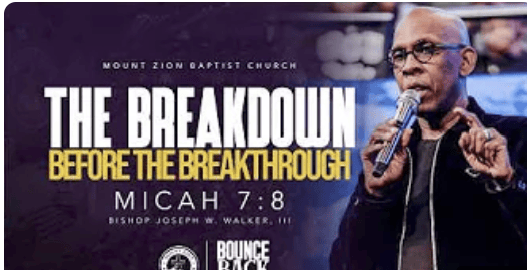
OCTOBER 2026 SERMON SERIES
Bounce Back
Part 1:
Bishop Joseph W. Walker, III
Mt. Zion Baptist Church, Nashville
October 4, 2026
Watch the full Sunday service: youtube.com/@mtzionnashville
Scripture: Micah 7:8 (NKJV)
Do not rejoice over me, my enemy;
When I fall, I will arise;
When I sit in darkness,
The Lord will be a light to me.
Prayer:
Lord, we give You glory and praise. Let Your Word go forth so that every yoke is destroyed and every chain is broken. Make us better because of what we are about to receive, and let somebody’s life be changed forever. In Jesus’ name, Amen.
I. INTRODUCTION
Today we begin the series Bounce Back, and the word of God comes from Micah 7:8. The message today is The Breakdown Before the Breakthrough.
Let me start with something every person under the sound of my voice clearly understands: life has a way of knocking us down when we least expect it. You can do everything right. You can pray, you can plan, you can prepare. You can show up on time, pay your tithes, and treat people right, and still be blindsided. The diagnosis you didn’t see coming. The email that started with “after consideration.” The phone call you got at two o’clock in the morning. The relationship you poured into, but the other person didn’t pour back, and they walked away.
If we’re honest, sometimes the worst part isn’t the fall itself. It’s the voice in your head afterward that says, “You should’ve known better. You should’ve seen this coming. You should’ve been stronger.” What I’ve learned in life is that a fall doesn’t just try to hurt you; it tries to rename you. The enemy loves to take what happened to you and convince you that it is who you are. But there is a difference between an event in your life and your identity in Christ. What you went through is only a chapter. Who you are in God is the whole book.
Faith has never exempted you from adversity. Faith teaches you that you must go through adversity, but you can come out with your head up and in your right mind. The Christian life is not measured by the absence of struggle; it is measured by your ability to bounce back. And let’s be very clear: God is never intimidated by your brokenness. He has never required perfection before He releases His power. God takes flawed people and does extraordinary things through them. Look at the résumé of God’s people:
- Abraham waited through impossibilities.
- Moses carried forty years of regret before he led a nation.
- David fell publicly before he worshiped passionately.
- Peter denied Christ before he preached to three thousand on the Day of Pentecost.
When you put their stories side by side, you see a pattern. You see resurrection after ruin, restoration after regret, and victory after vulnerability. No matter what circumstance a child of God finds himself in, the lowest moment should never become a lasting monument.
Look around this room today. You are sitting next to people who have a testimony. Life has knocked them down. For some of you, grief has not let go of its grip. Some of you have been knocked down by layoffs, restructuring, businesses that didn’t make it, and an economy that keeps on shifting, and you keep going to the gas station negotiating with the gas tank. Some of you have been knocked down trying to outrun the paycheck, by betrayal in relationships, by things that got crazy in school. Some of you have even mastered how to function in the midst of it. You’ve learned how to smile and post your highlight reel on Saturday while you cry in your car on the way home on Monday.
But you’re sitting next to somebody who doesn’t look like what they’ve been through. Some people in this room and watching today have literally been to hell and back. They have testimonies they can’t even talk about. All they know is they have seen the hand of God bring them out of places people thought they would never bounce back from. They’ve seen God heal, make a way, and show up right on time, and they join those in the biblical text who could tell you: if God did it for them, He can do it for you.
Regardless of your situation, this is your bounce back season. No matter what life dishes out, you’ve got to declare, “I may be down, I may be out, but God still has the last word over my life.” Somebody shout, “It’s my bounce back season!”
Micah’s World
Many of you may not be familiar with Micah, because you don’t hear many sermons about him. He is a minor prophet, not because of the insignificance of his work, but because of the length of his book. Micah prophesied during the reigns of Jotham, Ahaz, and Hezekiah, kings of Judah, in the eighth century before Christ. It was a turbulent period for the people of God. After the death of Solomon, the kingdom had divided: Israel to the north and Judah to the south. Micah lived to see the northern kingdom fall to Assyria. He saw Samaria destroyed, and Judah knew the threat was closer than it had ever been. Nations were falling, cities were being conquered, and families were being displaced. Eventually Assyria would invade Judah itself and capture its fortified cities. Micah was preaching to people who could look around and watch their world crumbling.
The writer of Ecclesiastes says there is nothing new under the sun. From one generation to the next, you can see patterns that continue to repeat themselves. So let’s take what Micah experienced and drop it into our world today, and see if there are some correlations.
Micah makes it clear that Judah’s greatest problem was not Assyria; it was what had happened to them spiritually. The nation had become deeply compromised. In chapter 2, Micah describes powerful people lying in bed planning how to take people’s houses and property. In chapter 3, the leaders who were supposed to protect the people were exploiting them instead. Judges could be influenced by money, priests taught for a price, and prophets prophesied for financial gain. Even while they talked about God, they dishonored God with their actions. That is why Micah 6:8 is such an important word for this generation:
He has shown you, O man, what is good;
And what does the Lord require of you
But to do justly,
To love mercy,
And to walk humbly with your God?
Micah 6:8 (NKJV)
By the time we get to chapter 7, Micah is grieving. He opens the chapter crying, “Woe is me!” He describes himself like someone walking through a vineyard after the harvest, looking for fruit and finding none. He’s looking for somebody faithful and can’t find anybody. Looking for somebody with integrity and can’t find anybody. Looking for somebody he can trust and can’t find anybody. In verse 3, corruption has infected leadership. In verse 5, relationships have deteriorated to the point that Micah warns against putting confidence in close companions. By verse 6, the breakdown has reached the family: a man’s enemies are the men of his own household.
So understand the picture: pressure from enemies outside the nation, corruption from leaders inside the nation, spiritual compromise among the people, and brokenness inside the house. Everywhere Micah would normally look for stability is shaking. Then verse 7 becomes the hinge that opens up verse 8:
Therefore I will look to the Lord;
I will wait for the God of my salvation;
My God will hear me.
Micah 7:7 (NKJV)
Then Micah squares his shoulders, turns to the enemies waiting for his demise, and says, “Do not rejoice over me, my enemy; when I fall, I will arise.” Let me make that make sense. Micah is saying, “God, my world is turned upside down. Things are crazy domestically, economically, and spiritually, so I’m going to look to You, because that’s where my strength comes from. My enemies are eating popcorn, waiting for my life to fall apart, but let me send them a message: put your popcorn up. My life ain’t over. God is about to turn my situation around. It may look bad now, but I’m on my way back.” Look at your neighbor and tell them, “I’m on my way back.”
Before Micah declares his comeback, he decides where he is going to look. “I’m not going to pretend the darkness isn’t real. I’m not going to sanitize my struggle. I’m not going to ignore my opposition. But I’m going to put my confidence in the God who is able to bring me back.” The God who permits the fall is the same God who empowers the rise. Somebody shout, “This is my bounce back season!”
II. FALLING IS INEVITABLE, BUT STAYING DOWN IS OPTIONAL
For a righteous man may fall seven times
and rise again.
Proverbs 24:16 (NKJV)
Let me use my Louisiana dialect to make this point: everybody gonna fall. I don’t care how big your Bible is or how well you speak in tongues. I don’t care how old you are. Everybody is going to have a moment in life where something hits you in your gut. You’re going to have a misstep, no matter how hard you try to avoid it. It is inevitable. Scripture teaches that the closer you walk with God, the more of a threat you are to the kingdom of darkness. The enemy never wastes ammunition on people who pose no danger to his agenda. Opposition is evidence that purpose is happening in your life.
Every person God has used significantly in Scripture ended up facing disappointment, betrayal, rejection, and delay. Joseph was in a pit long before he ended up in the palace. Elijah called down fire on Mount Carmel, but then he had to run for his life from Jezebel. Peter walked on the water before he sank in the water. None of them were exempt from the struggle. What separated them is that even though they fell, they had the power to say, “I’m not going to stay down. I’m going to get up.”
Look at what Micah says. He doesn’t say “if I fall.” He says “when I fall.” That one word changes everything. It is expectation, not exception. Solomon says in Proverbs 24:16 that a righteous man falls seven times and rises again. Somebody says, “You ain’t talking to me.” Oh yes, I am. The Bible doesn’t say the righteous never fall. It says he falls seven times. What makes him righteous is that he never allows what caused him to hit the ground to keep him on the ground. Getting up is what identifies you. Micah acknowledges the fall, but he also announces the rise. He recognizes the setback, but he prophesies the comeback.
If you would stop spending all your energy trying to justify or explain to people why you fell, and shift that energy into working on your comeback, you would see what God is trying to do. Look at your neighbor and say, “Put your energy into what God is about to do next.” Stop wasting time and energy on what happened in your past. God has something about to happen.
A. Stop Being Shocked by the Struggle
Beloved, do not think it strange concerning the fiery trial
which is to try you,
as though some strange thing happened to you.
1 Peter 4:12 (NKJV)
Why are you tripping? You act like this isn’t supposed to happen to you, like trouble is supposed to skip over your house. Peter says don’t think it strange. Why are you acting surprised? The fire is not strange. The fire is part of the process.
Look at the life of Jesus. In Matthew 3, Jesus is baptized, heaven opens, and a voice comes down from heaven saying, “This is My beloved Son, in whom I am well pleased.” Then, one chapter later:
Then Jesus was led up by the Spirit into the wilderness
to be tempted by the devil.
Matthew 4:1 (NKJV)
How can He experience affirmation in chapter 3 and attack in chapter 4? Because just because heaven spoke over you in one season doesn’t mean the devil won’t attack you in another. Just because you got a word and shouted on Sunday doesn’t mean the devil isn’t waiting on you Monday.
But I’ve got good news: don’t interpret your adversity as abandonment, because God is still with you. Whatever season you find yourself in, you are not by yourself. Look at somebody and say, “God is right there.”
- He never left Israel at the Red Sea.
- He never left Shadrach, Meshach, and Abednego in the fiery furnace.
- He never left Peter in that prison, or Daniel in the lions’ den.
- When Paul and Silas were in that prison, He was right there.
My grandmother used to sing, “He walks with me, and He talks with me, and He tells me I am His own.” Whatever you’re going through, God knows all about it, and He’s right there in the midst of it. So stop asking, “Why is this happening to me?” and start asking, “What is God trying to produce in me?”
B. Refuse to Let Embarrassment Become Entanglement
Outline references: Peter: John 18; The Angel at the Tomb: Mark 16:7
The enemy’s strategy goes well beyond making you fall. His goal is to convince you to stay where you fell. He knows one mistake will never destroy your future, but shame can. Guilt leads you to repentance; shame tries to convince you that you are beyond redemption. Shame says you are what you did. Grace says you are forgiven. God says you are His own. Grace says you’re awful. God says you are a lot.
A lot of people recover from the event but never recover from the embarrassment of the event. We live in a screenshot generation, where your worst moment can hit the group chat before you even make it home. People will replay it, repost it, and remind you of it. If you’re not careful, you’ll replay it too, until your memory becomes a chain around your future. Some of you are still imprisoned by the opinions of people who never had the authority to define you in the first place.
Can I push this a little further? Who told you that what happened to you was something you had to be ashamed of? Who decided this part of your story had to be hidden? Who taught you that if people knew the truth about what you’ve gone through, they would think less of you? Some of what we call embarrassment isn’t conviction from God; it is simply conditioning from people.
Some of us grew up with the mentality that what goes on in this house stays in this house. I understand family privacy. Everything doesn’t belong on Facebook, and everybody doesn’t deserve access to the intimate details of your life. Privacy is wisdom, but secrecy can become bondage. Privacy says everybody doesn’t need to know my business. Secrecy says nobody can know, because if they find out, something must be wrong with me.
Some of us were taught secrecy in the name of protecting the family. Don’t tell nobody what Daddy’s going through. Don’t tell nobody what Momma’s going through. The marriage is in trouble and we need counseling, but don’t tell nobody. Without realizing it, we learned how to protect an image while we were bleeding behind it. We learned how to look whole while we lived wounded. And here is the danger: what started out as “don’t tell nobody” eventually becomes “don’t ask nobody for help.” Secrecy becomes entanglement, because you cannot heal what you are committed to hiding.
Let me make an important distinction. I’m not telling you to tell everybody everything. Everybody isn’t safe, and everybody isn’t mature enough to handle your vulnerability. Jesus had the multitude, He had the twelve, and He had the three. Some things you just take to the grave. And some of you worry about people being in your business while you post a whole soliloquy on Facebook. Some things you just have to be quiet about. But hear me well: there ought to be somebody safe enough and spiritually mature enough that you can open up and share with. Have you ever considered that the part of you that you’re trying to hide may be the very part God wants to use to help somebody else experience His power and redemption?
I pray that we get delivered from cookie-cutter testimonies. Let’s tell the real testimony. You ain’t always been a bishop. You ain’t always been a pastor, a deacon, or an elder. Let’s talk about all your body count. Let’s talk about all the times you woke up and didn’t know where you were. It’s easier to sit in your righteous indignation and look down your glasses at people in the midst of a struggle, but when you tell your real testimony, they’re able to see that if God brought you out of that, He can bring them out too. Look at your neighbor and say, “You have no idea what God has brought me from.” Take fifteen seconds and give God glory that you don’t look like what you’ve been through.
We create narratives in church that everything is perfect, and people feel they can’t come because they’re struggling, so they walk in shame and guilt. You have no idea how many people in this house have already done what you did, ten times over. If it had not been for the grace of God! So you don’t have to be embarrassed to say:
- My marriage is in trouble.
- I almost gave up.
- I almost committed suicide.
- I almost walked away from school.
- I’m in a place I’ve never been in my life before.
- I tried something I should have never tried.
Just be honest. God will take that testimony, turn it around, and use it to bless somebody else. So if you’re looking for the perfect church, this ain’t it, and when you find it, don’t join it, because you’re going to mess it up. We’re all doing the best we can.
III. DARKNESS IS A SEASON, NOT A SENTENCE
Weeping may endure for a night,
But joy comes in the morning.
Psalm 30:5 (NKJV)
Micah says, “When I sit in darkness.” This is not a sentence; it’s just a season. Some of you have interpreted your dark season as something that will last forever, and I get it, because darkness can magnify your fear and minimize your faith. Darkness will tempt you to believe that if you can’t see yourself, maybe God can’t see you. But please understand: God does His best work in the dark.
- A baby comes out of the dark of the mother’s womb.
- The diamond on your finger came out of the dark of the earth.
- Jesus spent three days in the dark of a borrowed tomb before resurrection changed everything.
Micah says, “When I sit in darkness, the Lord will be a light to me.” He does not deny the darkness; he names the darkness. Faith is not pretending my pain does not exist. Faith is believing that God’s presence is greater than the pain I’m going through. Biblical faith does not require denial; it requires dependence. It is not denial of reality; it is confidence in a greater reality.
Notice that Micah does not say the Lord will immediately remove the darkness. He says the Lord will be a light in the darkness. Sometimes God changes your circumstance, and sometimes God changes you in the circumstance. Some of us prayed for God to take us out of seasons that later turned out to be the most important seasons of our lives:
- We learned compassion because we suffered.
- We learned patience because we had to wait.
- We learned dependence because our own strength ran out.
Don’t let a temporary season become a permanent conclusion. Just because you’re in the dark doesn’t mean the darkness lasts forever. Spring time cannot stop Fall from coming. No kind of night can stop the morning from coming. Weeping may endure for a night, but joy comes in the morning.
A. Do Not Build Permanent Theology Around Temporary Trouble
Somebody here has mistaken a season for your destiny. You’ve got to stop speaking permanent language over your current situation. Don’t build a permanent theology around temporary trouble. Somebody shout, “It is temporary!”
One of the dangers of prolonged pain is that you start believing it’s going to last forever, and you start crafting a theology and a construct of God around what you think is permanent: “It’s always going to be like this. That’s just the way my life is. God has allowed it, so I just accept it.” But be very clear, people of God: this is not the will of God for your life. What God is allowing you to go through was never meant to destroy you, only to develop you. When you build your theology around your faith and not around your fear, you are able to declare, “I am not going to look like what I’ve been through. God is still writing my story. He is the author and the finisher of my faith.”
B. Learn How to Sit in the Dark Without Surrendering to the Dark
What I’ve got to learn is how to sit in the darkness without surrendering to the darkness. Can I sit in it for a while without allowing it to sit in me? That’s what Micah says: “I may be sitting here now, but I am not going to be consumed by this situation.”
Outline references: Elijah: 1 Kings 19
One of the most powerful texts in Scripture is 1 Kings 19. It is a conversation about spiritual warfare and clinical counseling. After one of his greatest victories, the prophet Elijah finds himself running from Jezebel. Under the broom tree, Elijah says, “It is enough! Now, Lord, take my life.” But watch what God does. He doesn’t rebuke him. He doesn’t preach a sermon to him. He simply sends an angel to wake him: there is food right there; eat. After he eats, he goes to sleep. The next day the angel comes back and says, “Arise and eat, because the journey is too great for you.”
The most powerful spiritual thing you can do when you find yourself in a dark place is eat something, go to sleep, and let God deal with the rest. In other words, take care of yourself and let God take care of it. Some of you are up at two o’clock in the morning on the computer trying to figure it out. You’re sleep-deprived, your blood pressure is up, your anxiety is up, because you’re not sleeping and you’re not eating. There comes a moment when you’ve got to say, “Wait a minute. The Bible says God neither slumbers nor sleeps, so I might as well go to sleep.” Touch your neighbor and say, “Go to sleep. Let God deal with this.” You’ve got to take care of yourself.
The light shines in the darkness,
and the darkness did not comprehend it.
John 1:5 (NKJV)
IV. YOUR ENEMIES DO NOT GET THE LAST WORD. GOD DOES.
Your enemy does not get the last word,God does. One of the biggest temptations after a setback is letting the voices around you get louder than the voice of God within you. Let me say it slowly: every fall attracts an audience. And nowadays the audience comes with a comment section. Your enemies will always celebrate your struggle and stay quiet during your successes. You can be doing great things and never hear from them; they’re watching, they just don’t like it. But the moment something happens in your life, they break their ankles getting to the comment section. They come out like cicadas. There will always be critics who sit back and decide that one mistake canceled your purpose.
Micah understood that, which is why he addresses his enemies before he addresses his circumstances: “Do not rejoice over me, my enemy.” Micah had a sense of discernment; he knew exactly who was in his world. When you’ve been in this thing a long time, you learn that everybody who smiles in your face is not your friend, and at a certain level of discernment, you know exactly who your enemy is. So Micah speaks directly to his enemy: “Don’t you rejoice over me, because I won’t be here the next time you see me.”
A. Do Not Respond to Critics with Explanations. Respond with Elevation.
Outline references: Paul: Acts 28; David; Joseph; Jesus
Micah doesn’t argue with the enemy, and he doesn’t defend himself. He doesn’t waste energy trying to convince people who’ve already made up their minds. He simply announces what God is about to do. There comes a point in your maturity when you have to stop explaining yourself to people who’ve already decided they’re not going to understand you. One of the biggest mistakes we make is giving emotional real estate to people who have no spiritual authority in our lives. You keep replaying the conversation. You keep rehearsing the criticism. But hear me well: the opinions of people have never had the authority to override the purpose of God over your life. You are not who they say you are. You are who God says you are. That means:
- The diagnosis does not have the last word.
- Disappointment does not have the last word.
- The divorce does not have the last word.
- The financial setback does not have the last word.
- That class you failed does not have the last word.
- Your depression does not get the last word.
- Your critics do not get the last word.
- Even your past does not get the last word.
God gets the last word. That’s why you don’t respond to your critics with explanation; you respond with elevation. The fact that I keep showing up is evidence that whatever was sent didn’t take me out. If I keep showing up, I’m going to keep on striving and keep on winning. The way you respond to your critics is to keep showing up and keep blowing up. Look at somebody and say, “Keep showing up and blowing up.” Keep going to the next level. Keep doing what God told you to do. Don’t come down to entertain people who are negative in your life. Stop chasing validation and start chasing the purpose God has placed on your life.
B. Say It Before You See It
God . . . calls those things which do not exist
as though they did.
Romans 4:17 (NKJV)
Outline references: Abram; Gideon; Ezekiel; Jesus
As I close, the Bible says Micah made this declaration: “I will arise.” As simple as that sounds, go back and listen to the context. Politically, economically, socially, spiritually, and even domestically, everything around Micah has gone crazy. He is like a man on his back in a dark hole, with people all around him eating popcorn, waiting to see how this plays out, and Micah says, “I will arise.” He preaches to himself. He speaks to himself. He speaks to where God is about to take him.
Death and life are in the power of the tongue.
Proverbs 18:21 (NKJV)
In other words, you’re about to learn, people of God, how to speak yourself to life and not speak yourself to death. Micah does what Romans 4:17 says: he calls those things which do not exist as though they did. Speak to where God is about to take you, not where you are right now. Speak yourself across that stage. Speak yourself into that house. Speak yourself out of that hospital. Speak yourself out from under the pressure and out of that negative situation. Open up your mouth and speak where you are going. Micah’s testimony is that whatever situation I find myself in, I’m going to come back.
I’m fascinated by how some people have such a level of resilience. If I could pass the mic around this room, you would be blown away by some of the testimonies of what people have come back from. What is it that makes people resilient enough to bounce back?
Those who play basketball with me know I’m a real basketball player. Your pastor can ball; I’ve got witnesses. All I need is a pick. The only reason I’m here pastoring you and not playing for the Philadelphia 76ers is the permissive will of God. If it were my way, I’d be in Philadelphia right now. Nevertheless, I appreciate y’all.
Here’s a simple illustration. This ball responds because I am in control of it. My hand is over it, and I’m going somewhere. The harder I hit the ball, the higher it bounces. The harder I slam it, the higher it goes. The ball only responds the way it does because it’s reacting to what I just did to it.
Now here is the same ball, the same brand, in the same hand. But if I throw this one down, it doesn’t do anything, because this ball doesn’t have what that ball has inside of it (this ball is not aired up. It’s not about the brand. It’s not about the name on it. It’s not about how much it cost. That ball has something on the inside that this ball does not have. That’s why, when the devil throws some of you down, you fall flat and never bounce back: you don’t have what’s on the inside. Those of us who bounce back don’t do it because of our money, our degree, or our flex. We bounce back because greater is He that is in us than he that is in the world.
The devil said, “I’m going to kill you,” but the harder he threw me down, the higher I went. Every time he tried to destroy me, every time he tried to silence me, I bounced back. The devil is a liar. Your future is about to bounce back. Your family is about to bounce back. Everything God promised is about to bounce back.
Wait a minute, I forgot to tell you something. Micah addressed his enemy while he was on his back in the dark and said, “I will arise.” That means the same enemies who saw him on his back would have to watch when God raised him up. The Lord prepares a table before me in the presence of my enemies. God is going to give them a front-row seat to your bounce back.
Outline references: David at Ziklag: 1 Samuel 30
V. CLOSING INVITATION
This is a different kind of word, for people who, like Micah, can say, “Pastor, everything I thought was stable is shaky right now. I came in today because I had had enough. God, You gave me a word. You let me know that this little chapter is not the entire story, and You’re still writing my book. I’m not going to speak permanent language over something temporary. And God, You put me in a community of people who identify with some of my struggles. There’s no space for shame here, only space for family. By the grace of God, we are what we are.”
Today I’m talking to somebody God spoke to who needs a relationship with Jesus Christ. He’s the best thing that could ever happen to you. Maybe you’re saying, “Pastor, I want to dedicate my life to Jesus. I’m ready to make that decision. I want to get my fire back and be where God wants me to be.” Today is your day to say yes.This is your bounce back season.
Have a blessed new week with the Lord! ❤️


